Disaster Technology Training That Builds Real Capacity

Greater Houston Disaster Alliance Workshop
When disaster strikes, nonprofits providing critical support need to move quickly. They cannot afford to learn new systems in the middle of a crisis. To ensure Greater Houston has the networks, tools, and shared workflows needed to respond rapidly and effectively, the Greater Houston Disaster Alliance hosted a hands-on disaster preparedness workshop for its Core and Community Partners focused on our system coordination platforms.
Connective, the Disaster Alliance’s system coordination partner, led partners through “blue sky” training on the Connective portal, coordinated intake, shared data, and response workflows. The session helped participating organizations build familiarity with the tools and processes that can be activated after a disaster, strengthening the region’s ability to coordinate assistance, reduce duplication, and connect impacted residents to support more quickly.
Table of Contents
- About the Disaster Alliance
- Why “Blue Sky” Disaster training Matters for Nonprofits
- Introducing the Priority Zip Code Map: Aligning Community Need and Nonprofit Coverage
- Connective Tech Enhancements: Improving Nonprofit Disaster Response
- Up Next for the Disaster Alliance
- Take the Next Step: Build Disaster Readiness
About the Disaster Alliance
The Greater Houston Disaster Alliance was formed in 2023 by Greater Houston Community Foundation and United Way of Greater Houston. With over 35 years of combined experience leading disaster recovery efforts, the Disaster Alliance was established to ensure our region has the networks and systems in place to accelerate recovery effectively in times of disaster.
Backed by initial investments from Enbridge and Phillips 66, the Disaster Alliance has made meaningful progress in catalyzing public and private partnerships and advancing a year-round focus on preparedness and resilience to reduce the harms caused by disasters on our most vulnerable residents.
With continued investment from its founding lead sponsors—and new investments from JPMorganChase and Texas Mutual Insurance—the Disaster Alliance is now positioned to expand both its influence and impact across the region.
Why “Blue-Sky” Disaster Training Matters for Nonprofits
Blue-sky training, or training during non-disaster periods, moves technology from theoretical to operational. In real response and recovery, unfamiliar tools create delays, duplicative work, and data gaps which all slow down critical assistance for residents. By training in advance, Disaster Alliance collaborators build muscle memory, improve data quality, and reduce friction across organizations. Training like this enables faster, more coordinated disaster recovery.
The Disaster Alliance’s preparedness and resilience model relies on coordinated intake, shared data, and aligned service delivery across a network of nonprofits. Consistent training before disaster strikes ensures partners are ready to use shared tools quickly, reducing ramp-up time and helping accelerate recovery when it matters most. Blue-sky training ensures that during activation (or a disaster):
- System coordination tools function as intended
- Reliable, actionable data guides funding and prioritization decisions
- Nonprofit organizations operate as a network and not in silos
- Recovery efforts are faster, more equitable, and more transparent
Connective will also provide refreshers and office hours to provide training for agency staff in the wake of a disaster.
Introducing the Priority Zip Code Map
Aligning Community Need and Nonprofit Coverage
At the workshop, the Disaster Alliance unveiled a priority zip code map to help the collective nonprofit sector strengthen disaster preparedness, improve coordination, and advance equitable recovery. This dynamic tool overlays two key data points, economic vulnerability (such as poverty and ALICE households) and nonprofit service density (the number of Disaster Alliance Core and Community Partners serving each area), to spotlight where help is needed most and where disaster service providers may or may not already be in place.
Understanding the Map’s Color Coding & the Disaster Alliance’s Action Plan
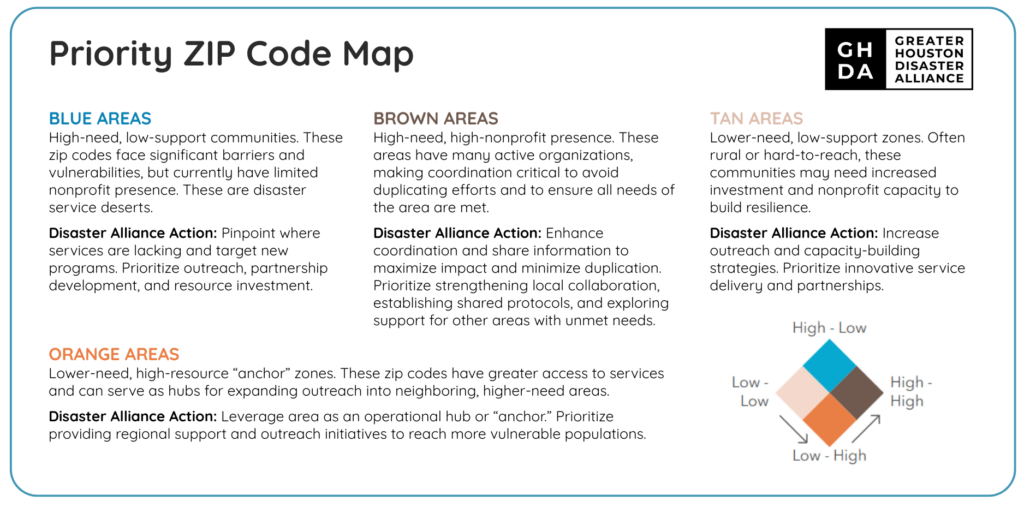
Leveraging the Map
This map aims to inform the Disaster Alliance’s funding strategies, advocacy campaigns, and strategic planning by presenting clear, place-based evidence of community need. We encourage other nonprofit leaders to:
- Regularly review the priority zip code map to monitor shifts in need and service coverage during a disaster.
- Integrate map data into grant proposals and advocacy efforts to strengthen your case for funding and support.
- Share map insights with stakeholders, including board members, funders, and local government, to align efforts and multiply impact.
- Collaborate with nearby organizations to create or join coalitions in high-need or high-density areas.
The priority zip code map is more than a data visualization, it’s a strategic planning resource for building a more resilient and connected greater Houston region. By acting on these insights, the nonprofit sector can enhance the support each community needs before, during, and after disaster strikes.
Connective Tech Enhancements: Improving Nonprofit Disaster Response
Strong disaster response starts before landfall with the systems that power coordination, communication, and decision making. As the Disaster Alliance’s system coordination partner, Connective is improving the technology and infrastructure that helps nonprofits collaborate more effectively and serve residents faster. Through this formal collaboration with Connective, the Disaster Alliance’s Core and Community Partners will have the ability to:
- Standardize intake forms for more consistent client data
- Share pre- and post-construction assessments to streamline and standardize home repair and to facilitate rematching the home to other agencies with available resources if an agency has previously denied them
- Use client status checkers to reduce client anxiety and staff workload
- Benefit from case prioritization metrics in the portal for easier decision-making
- Experience Connective survey usability improvements for better feedback and data collection
- Use new workflows to facilitate the leverage of FEMA funding and other external funding sources
- Connect clients to FEMA, Disaster Snap, and Homeowner Property Tax Exemptions through Connective’s Unlock My Benefits Network.
- Access updated training manuals and partner training sessions
- Enhance survey and data-sharing efforts across its nonprofit network
Up Next for the Disaster Alliance
Hurricane Harvey Retrospective
Ten years after Hurricane Harvey, the greater Houston region has made significant investments in recovery and resilience across Harris County. The Disaster Alliance is convening partners across sectors to develop a ten-year retrospective to assess how those efforts have shaped outcomes at the household, neighborhood, and systems levels.
The report, scheduled to be launched in August 2027, will examine progress across three core dimensions:
- Supported & Connected People
- Safe & Adaptive Places
- Responsive & Aligned Systems
The Disaster Alliance seeks to synthesize existing studies, investments, and data to identify what has worked, where gaps remain, and what actions are needed to strengthen regional resilience moving forward.
Disaster Readiness Profile
The Disaster Alliance is developing a Disaster Readiness Profile, a practical, evidence-informed framework designed to strengthen the capacity of the region’s nonprofit disaster network. This profile provides nonprofits with a clear roadmap for developing strong disaster readiness and recovery practices. By using this tool, nonprofits will be able to:
- Strengthen internal systems for preparedness and recovery
- Build staff confidence and skills
- Stay aligned with regional communication and coordination efforts
- Better support the clients and communities served
The Disaster Readiness Profile is designed as a self-coaching tool to help nonprofits build, document, and implement practical disaster readiness processes, without reinventing the wheel. It offers clear and simple strategies and guidance to strengthen day-to-day readiness, then helps teams measure progress over time by using the profile at regular intervals to show growth, close gaps, and stay prepared for activation.
Just as important, the profile is built for learning alongside peers: it encourages each organization to regularly participate in Disaster Alliance collaborative meetings, where the most current guidance on disaster readiness and resilience is shared. The result is a stronger internal system for preparedness and recovery, more confident staff with repeatable practices, better alignment across the regional nonprofit ecosystem, and improved outcomes for the clients and communities the Disaster Alliance’s partners serve.
Take the Next Step: Build Disaster Readiness
If your organization supports disaster relief, disaster recovery, home repair assistance, or emergency financial assistance, don’t wait for the next storm to find gaps in your process. Build readiness now by joining the Disaster Alliance blue-sky to gain access to coordinated tools like Connective—so your team can participate of coordinated intake, share clean data, and partner seamlessly the moment activation begins. When the Disaster Alliance, and its grantees, can more clearly identify, implement, and align, our region can deliver faster, more equitable recovery for Greater Houston.
For Nonprofits
Review to see if you meet the Disaster Alliance’s eligibility criteria and can adhere to its nonprofit partner policies to be classified as either a Core or Community Partner. Eligibility is based on your organization’s ability and capacity to provide specific disaster services given various disaster scenarios and populations served. With questions, email [email protected].
For Supporters
Donate to strengthen year-round disaster preparedness, recovery, and resilience efforts and ensure that Greater Houston has the networks and systems in place to respond rapidly and effectively in times of disaster.
For Everyone
Subscribe to receive disaster preparedness resources and invitations to select Disaster Alliance convenings that foster collaboration and highlight best practices, contributing to a more resilient greater Houston community.
More Helpful Articles by Greater Houston Community Foundation:
- Turning Noncash Assets into Community Impact: A Nonprofit’s Guide
- Solar Batteries Helping Houston’s Most Vulnerable Communities
- Exploring Climate Philanthropy: Insights from Peer Leaders
- Economic Mobility Learning Series: Child Poverty Action Lab
This website is a public resource of general information that is intended, but not promised or guaranteed, to be correct, complete, and up to date. The materials on this website, including all comments and responses to comments, do not constitute legal, tax, or other professional advice, and is not intended to create, and receipt or viewing does not constitute, nor should it be considered an invitation for, an attorney-client relationship. The reader should not rely on information provided herein and should always seek the advice of competent legal counsel and/or a tax professional in the reader’s state or jurisdiction. The owner of this website does not intend links on the website to be referrals or endorsements of the linked entities.