How Does Charity Help With Taxes?
Professional Advisor Partnerships

It’s a question that many donors wonder: does giving to charity actually reduce what you owe at tax time? The honest answer is sometimes—and how much depends on a number of factors that you should understand long before you give. The type of assets you contribute, whether you qualify to itemize deductions, and the timing and structure of your gift all play a role in determining what tax benefit, if any, you’ll receive.
This guide walks through the essentials of charitable contribution deductions: when they apply, how much you can deduct, and how thoughtful planning can help you give more effectively. Whether you’re a first-time donor or are revisiting your strategy after a major financial event, knowing how charitable giving interacts with your tax picture is the start of a smarter approach to philanthropy.
Greater Houston Community Foundation does not provide tax, legal, or accounting advice. We encourage you to work with your clients’ tax attorney, CPA, or financial advisor to ensure any charitable strategies align with their overall financial plans.
Key Insights
- Charitable donations can reduce taxable income taxes, and the benefit is proportional to your marginal tax rate.
- Most cash contributions require itemizing deductions to be eligible for a tax deduction; non-itemizers currently have limited options.
- Donating long-term appreciated assets can eliminate capital gains exposure while generating a fair market value deduction, which is often much more tax-efficient than giving cash.
- IRS deduction limits apply: cash gifts to public charities cap at 60% of AGI; appreciated asset gifts cap at 30% of AGI, with excess carried forward up to five years.
- Donor advised funds allow donors to take an immediate deduction in a high-income year while recommending grants to nonprofits over time. With Greater Houston Community Foundation as a philanthropic partner, donor advised funds make it easy to give in a way that is flexible, tax-smart, and aligned with your values and long-term impact goals.
- Giving Individual Retirement Account (IRA) assets—possibly through a Qualified Charitable Distribution (QCD) during your lifetime or by naming a charity as a beneficiary of your retirement account—can be one of the most tax-efficient forms of charitable giving, offering estate tax reduction and helping heirs avoid the income tax burden that would otherwise apply to inherited retirement funds.
Table of Contents
- Does giving to charity reduce taxes?
- Are charitable donations tax deductible if you don’t itemize?
- When do you receive a tax benefit from giving?
- The capital gains tax and why appreciated assets are often more powerful than cash
- Everything about IRS deductibility limits
- Is it worth donating to charity for taxes? Some strategic considerations.
- How donor advised funds offer more than tax deductions for giving
- What donors and advisors say about giving with the Community Foundation
- Charity and taxes FAQs
- Connect with the Community Foundation to explore tax-smart giving
Does giving to charity reduce taxes?
Charitable donations can reduce your taxable income, which in turn may lower your overall tax liability. A tax deduction does not reduce your taxes dollar-for-dollar. Rather, it reduces the amount of income on which you’re taxed. The actual savings you see depends on your marginal tax rate.
Here’s a straightforward example:
If you’re in a high-income year, say in the 32% federal tax bracket, and you make a $100,000 qualifying charitable contribution, that could reduce your tax bill by roughly $32,000, depending on your client’s individual tax situation. Under the OBBBA, filers should be aware that a 0.5% AGI floor may affect the net deductible amount. For many donors, this kind of gift happens in years with bonuses, business sales, or appreciated assets. Your tax advisor can help you calculate the precise benefit given your income and filing status.
Are charitable donations tax deductible if you don’t itemize?
Whether your donation qualifies for a deduction begins with a foundational question: are donations tax deductible for your situation? The answer depends on how you file.
To claim most charitable contribution deductions for cash gifts, you need to itemize your deductions rather than take the standard deduction. For many donors (especially those whose total deductible expenses fall below the standard deduction threshold) this means charitable giving offers no direct tax reduction in a given year, even when made to qualified organizations.
The standard deduction for tax year 2026 is $16,100 for single filers and $32,200 for married couples filing jointly. Because these thresholds are relatively high, a large share of taxpayers don’t itemize and therefore don’t receive a direct tax benefit from individual charitable gifts.
The real tax advantages of charitable giving come into play when gifts are large enough to exceed the standard deduction threshold—which is precisely why many donors are becoming more intentional about when and how they give. While the OBBBA reinstated a modest deduction for non-itemizers (up to $1,000 for individual filers and $2,000 for joint filers), the clients who benefit most from charitable giving tax strategies are those whose gifts are structured to unlock itemized deductions above the threshold.
When do you receive a tax benefit from giving?
For donors who do itemize, the tax advantages of charitable giving can be meaningful. There are many factors that determine whether your contribution will qualify for a deduction:
- The organization must be a qualified nonprofit. Donations must be made to organizations recognized by the IRS as tax-exempt, generally 501(c)(3) public charities or certain private foundations. Gifts to individuals, political campaigns, or non-qualified organizations are not deductible.
- Your contribution must be documented. Bank records, written gift receipts or acknowledgment letters from the charity, and a qualified appraisal for non-cash gifts over $5,000 are all required to substantiate your deduction.
- The gift must be irrevocable. Once you make a qualifying contribution to a charitable organization or donor advised fund, the contribution is permanent and dedicated to charitable purposes.
- Donors cannot receive more than incidental benefits in exchange for a charitable contribution. If you receive something of meaningful value (a gala dinner ticket, for instance) only the portion of your gift above the fair market value of that benefit qualifies as a deduction.
Donors who meet these criteria and itemize their deductions may claim a deduction on their federal income tax return for the value of their qualifying gifts, subject to AGI-based limits.
The capital gains tax and why appreciated assets are often more powerful than cash
One of the most compelling yet underutilized tax benefits in charitable giving involves long term capital gains. When you donate an appreciated asset you have held for more than one year, you can generally deduct the asset’s full fair market value without recognizing or paying capital gains tax on the appreciation.
By contrast, if you sold those shares first and then donated the proceeds in cash, you would owe capital gains tax on the appreciation before any charitable benefit. Donating appreciated stock directly to a qualified organization or donor advised fund removes that intermediate tax step entirely.
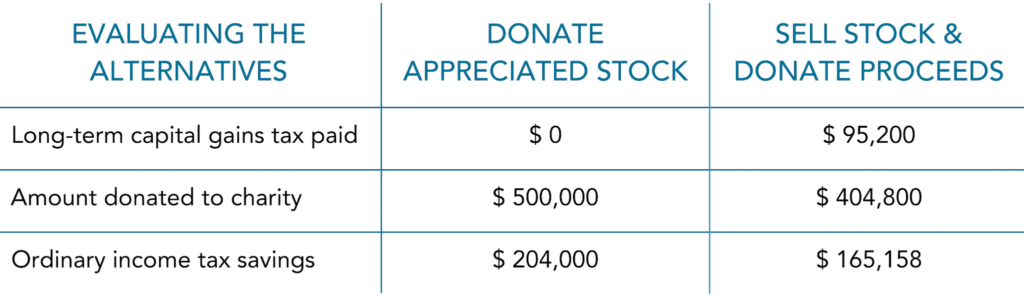
This same principle can extend far beyond publicly traded securities. Donating illiquid assets (like privately held business interests, partnership interests, and other illiquid holdings) can allow donors to contribute highly appreciated property while avoiding capital gains exposure. Similarly, donating property to a nonprofit can yield a deduction based on the property’s appraised fair market value, potentially paired with capital gains avoidance on appreciated real estate.
Because these strategies involve complex assets and multiyear planning, we recommend your professional advisors partner with the philanthropic advisors at Greater Houston Community Foundation before making a significant noncash gift.
Everything to know about IRS deductibility limits
A common point of confusion involves IRS limits on how much you can actually deduct in a given tax year. These limits are based on your adjusted gross income and vary depending on the type of gift and the recipient organization. The table below shows some of the most common scenarios.
| Type of gift | IRS deduction limit | Notes |
| Cash donations to public charities | Up to 60% of AGI | N/A |
| Appreciated securities (held > 1 year) | Up to 30% of AGI | Avoid capital gains; deducted at fair market value |
| Real estate or complex assets | Up to 30% of AGI | Deduction of fair market value if held >1 year; subject to appraisal and rules |
| Donations to private foundations | Varies usually 30% of AGI, sometimes 20% | Only some private foundations will qualify; cash = 30%; appreciated assets may be 20% |
| Gifts where you receive a benefit | Only the excess portion | Deduction limited to amount above value received |
If your total qualifying contributions in a tax year exceed these limits, the unused portion is not lost. The IRS allows excess contributions to be carried forward for up to five additional tax years, giving donors flexibility to plan large gifts without permanently forfeiting deductions. This means that a donor who makes a large gift in year one can apply the unused deduction against their taxable income in years two through six, spreading the tax benefit across multiple filing periods.
It’s also worth noting that for donors with very large estates, charitable giving plays a significant role in their broader estate transfer strategies. Structuring gifts across generations or making charitable bequests can help you mitigate your exposure to the generation skipping tax and other estate taxes. The Community Foundation can work alongside your estate planning attorney to make sure your financial, philanthropic, and estate plans all work in concert.
Is it worth donating to charity for taxes? Some strategic considerations.
Charitable giving is ultimately about impact—and it’s worth being clear about what tax benefits actually do and don’t accomplish. Making a charitable gift is never the more financially advantageous choice compared to simply keeping the asset; the tax benefits reduce the net cost of giving, but they don’t make giving more profitable than not giving. What they do accomplish is meaningful: by approaching your giving with charitable giving tax strategies in mind, you can reduce what you’d otherwise owe in taxes, and direct more resources toward the causes you care about over time.
With this in mind, there are a few techniques worth knowing:
- Timing contributions to high-income years. If you anticipate a year with significantly higher income (due to a business sale, a large bonus, or an RMD event) accelerating charitable contributions into that tax year can maximize the deduction against a higher marginal rate.
- Bunching contributions. Rather than giving smaller amounts annually, some donors consolidate two or three years of charitable giving into a single tax year. This approach can push total itemized deductions above the standard deduction threshold, unlocking the tax benefit in a concentrated year.
- Giving appreciated assets rather than cash. As discussed above, contributing long-term appreciated securities or other assets directly can produce a dual benefit: a full fair market value deduction plus avoidance of capital gains tax on the appreciation.
- Utilizing a donor advised fund for flexibility. A donor advised fund allows you to contribute in a tax-advantageous year, claim the deduction immediately, and then distribute grants to nonprofits over time. This decouples the timing of the tax benefit from the timing of the actual grant, and provides unprecedented flexibility for donors looking to give smart.
These strategies aren’t mutually exclusive, and the the Community Foundation’s philanthropic advisors are ready to work with you to maximize your client’s philanthropic impact while minimizing their tax liability.
How donor advised funds offer more than tax deductions for giving
Among the most powerful tools in a tax-smart philanthropic strategy is the donor advised fund. Donor advised funds offer more than a simple tax benefit—they allow you to make a contribution to a sponsoring organization like Greater Houston Community Foundation, receive an immediate tax deduction in the year of the gift, and recommend grants to nonprofits over time, on your own schedule. The contributed assets are invested and grow tax-free while they remain in the fund, amplifying the eventual charitable impact.
While DAFs can be useful for almost any donor, they’re particularly well-suited to situations like these:
- You’ve had a high-income year and want to maximize charitable contribution deductions before year-end, even if you haven’t yet decided which nonprofits to support.
- You want to contribute appreciated assets (stocks, real estate, or complex holdings) and benefit from both the capital gains avoidance and the deduction, while directing grants to specific causes over time.
- You want to simplify your philanthropic record-keeping by consolidating multiple gifts through a single vehicle with a single tax receipt.
- You’re planning a bunching strategy and want a centralized account to hold the concentrated contribution until you’re ready to distribute.
The Community Foundation’s philanthropic advisors work with donors and their advisory teams to ensure that DAF contributions are structured in a way that aligns with their broader financial and estate planning goals. Third-party investment management is also available for funds with balances of $500,000 or more, allowing donors to maintain established advisor relationships within their philanthropic account.
What donors and advisors say about giving with the Community Foundation
The impact of working with a knowledgeable philanthropic partner goes beyond tax calculations. For many donors, the greatest benefit is the clarity and confidence that comes from a clear giving plan, along with a trusted partner like the Community Foundation who helps turn that plan into measurable impact and lasting returns on their philanthropic investment.
Donor perspective
“We pulled together a plan for distribution for the short term, intermediate term, and long term. It wasn’t easy, it was hard for me, but the Community Foundation was instrumental.”
Ken Bohan, Community Foundation Fundholder
Advisor perspective
“Another interesting way that I use Greater Houston Community Foundation as a tool is when we have clients from time to time who are new to wealth. They’ve sold a company or experienced a similar liquidity event and they do not know the first thing about philanthropy, but they want to learn. They could always donate to a big donor advised fund sponsor somewhere, but they really like the idea of getting to know other people who are similarly situated—to learn how to be a careful donor, to learn about opportunities, to meet other like-minded people. Greater Houston Community Foundation is a wonderful way to do that.”
Conversations about giving plans, asset selection, timing, and impact are the ones we have with donors and their advisors every day. If you need to have a structured conversation around your giving, the Community Foundation can help facilitate it.
Charity and taxes FAQs
What is the difference between choosing itemized deductions and the standard deduction?
When you file your taxes, you choose between the standard deduction (a fixed amount based on filing status) and itemized deductions (the sum of qualifying expenses like mortgage interest, state and local taxes, and charitable gifts). You only receive a tax benefit from individual charitable gifts if your total itemized deductions exceed the standard deduction threshold.
Do you get a bigger tax refund if you donate to charity?
Charitable giving reduces taxable income, which can lower the amount of tax you owe. If you’ve had taxes withheld throughout the year, this could result in a larger refund at filing. However, the deduction alone does not create a refund; it reduces your tax liability proportionally to your marginal rate and the amount you give.
Can I claim charity donations on my taxes?
Yes, if you meet the eligibility requirements. You must give to a qualified 501(c)(3) organization, keep appropriate documentation, and, for most cash contributions, itemize your deductions rather than take the standard deduction. Donations of appreciated assets can offer additional tax advantages even for some donors who don’t itemize.
How do you reduce your taxable income through charitable giving?
The most direct way to reduce your taxable income through charitable giving is to contribute qualifying assets to a recognized nonprofit or donor advised fund, itemize your deductions, and claim the charitable deduction on your federal return. Strategies like bunching, contributing in high-income years, and giving appreciated assets can further increase the deduction’s impact on your taxable income.
Connect with the Community Foundation to explore tax-smart giving
Does charitable giving help with taxes? It can. While charitable giving is, at its heart, about the impact you want to create in your community, the tax benefits are a meaningful complement to that purpose. With the right approach, those tax benefits can also enable you to direct more over time to the causes you believe in and the legacy you want to leave behind.
The Community Foundation’s team of philanthropic advisors collaborates with donors and their professional advisors—financial planners, CPAs, family office teams, and estate attorneys—to design giving strategies that align philanthropic goals with broader financial planning. Whether your client is giving for the first time, preparing for a significant liquidity event, or refining their estate plan, we’re here to help.
Ready to take a more strategic approach to your giving? Contact Andrea Mayes, Senior Director of Charitable Solutions, or call 713-333-2210 to get started.
More Helpful Articles by Greater Houston Community Foundation:
- Connecting Estate Planning and Charitable Giving
- How Do Community Foundations Work? Unlocking the Power of Community
- Choosing the Right Strategy for DAF Investments
- Making an Impact with Small Business Philanthropy
- Charitable Giving and Financial Planning Checklist
This website is a public resource of general information that is intended, but not promised or guaranteed, to be correct, complete and up to date. The materials on this website, including all comments and responses to comments, do not constitute legal, tax, or other professional advice, and is not intended to create, and receipt or viewing does not constitute, nor should it be considered an invitation for, an attorney-client relationship. The reader should not rely on information provided herein and should always seek the advice of competent legal counsel and/or a tax professional in the reader’s state or jurisdiction. The owner of this website does not intend links on the website to be referrals or endorsements of the linked entities.