Building Bridges for Deeper Impact: Inaugural Houston Economic Mobility Summit
Amplified Giving Series
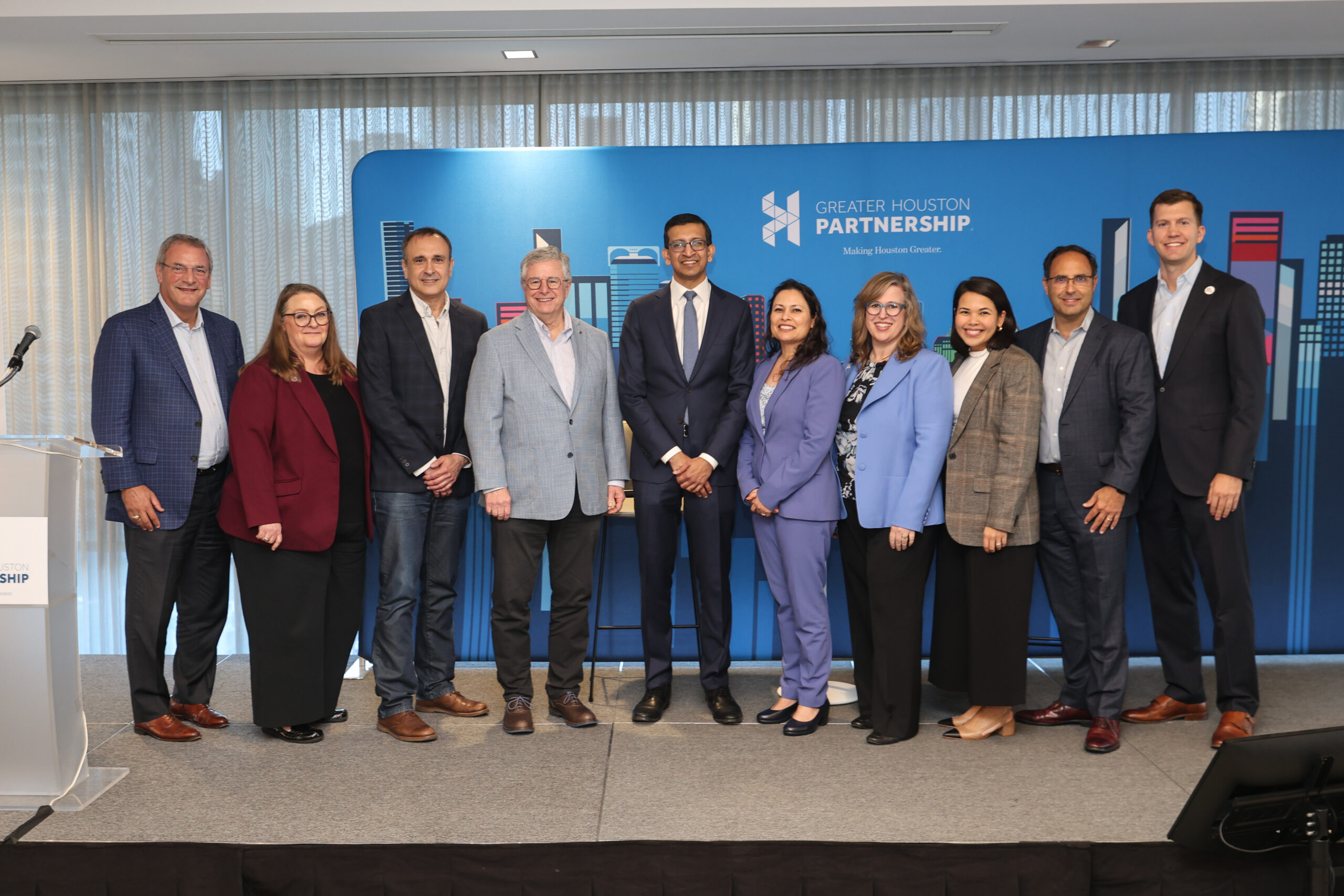
Greater Houston Community Foundation, Good Reason Houston, Greater Houston Partnership, Kinder Institute for Urban Research, and United Way of Greater Houston hosted the inaugural Houston Economic Mobility Summit on October 29-30, convening over 150 cross-sector leaders from business, philanthropy, government, academia, and the nonprofit sector. The Summit expanded knowledge of economic mobility, strengthened relationships, and explored the potential for collective action to drive meaningful, measurable progress on economic mobility in Houston.
The two-day Summit featured two of the nation’s foremost authorities on economic mobility: Dr. Raj Chetty, Director of Opportunity Insights and Harvard Economist, and Sarah Rosen Wartell, President of the Urban Institute. Three Houston leaders also offered insights into local data, research, and philanthropy shaping Houston’s trajectory: Dr. Flávio Cunha, Director of the Center for Economic Mobility at Rice University’s Kinder Institute for Urban Research, Rich Kinder, Co-Founder of Kinder Morgan and Chairman of the Kinder Foundation, and Ann B. Stern, President and CEO of Houston Endowment.
Continue reading this article for an in-depth summary of Summit highlights and key takeaways.
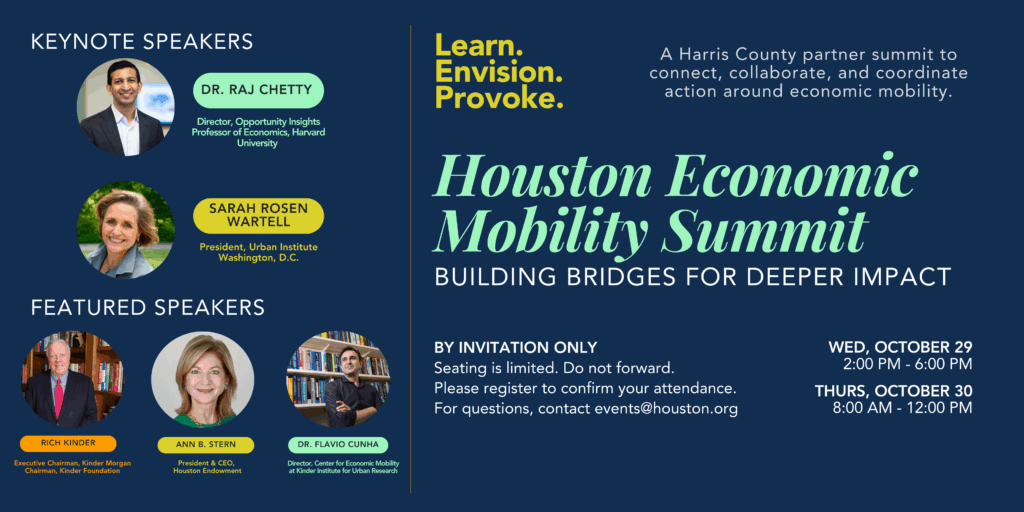
Table of Contents
- The Case for Coming Together
- Day One: Understanding Economic Mobility in Houston with Dr. Raj Chetty
- Day Two: From Principles to Practice with Sarah Rosen Wartell
- Greater Houston Community Foundation Advances Upward Mobility
- Bold, Aligned Action
The Case for Coming Together
Building Bridges for Deeper Impact
Can Houston lead the nation in advancing economic mobility? That was the central question posed to leaders at the Summit. Houston has the potential, but doing so will require more ambitious, collaborative solutions across sectors to drive progress on key drivers of upward mobility. As Steve Kean, President and CEO of Greater Houston Partnership, noted in his opening remarks, “When Houstonians decide to get together and do something, it gets done.” These five leading organizations, along with everyone in the room, share a bold vision for Houston’s future: that, regardless of where a person starts, they can move up the economic ladder. Houston has long been considered a place of opportunity, but that promise is not reaching everyone, and for many, upward mobility is becoming increasingly complex to achieve.
Despite a slight decline in poverty rates over the last decade, according to new data from the United States Census Bureau, Houston is now the most impoverished major city in the nation, with one in five residents living at or below the Federal Poverty Level. However, we know that Houston has unique and valuable assets that position it to come together to confront this challenge, strengthen economic mobility, and help more residents climb the income ladder. Additionally, our region has long benefited from the leadership, dedication, and deep expertise of countless individuals and organizations who have been working for years to expand opportunity and improve economic mobility. Yet, too often, day-to-day demands and the need to be responsive to ongoing and immediate community needs make it difficult for this broad ecosystem of partners to come together to learn, reflect, align, and strategize collectively.
The Houston Economic Mobility Summit was designed to honor and build on that ongoing work by creating space for shared learning, connection, and collaboration. Over two days of table talk discussions and cross-sector dialogue, leaders expressed a shared desire to continue working together and to leverage what has already been built to move this work forward. The Summit is just the first step toward building the trust and alignment needed for bolder, more collaborative solutions. By working together more frequently and collaboratively, we can preserve the promise of the American Dream right here in Houston.
“We believe that Houston can and should—and dare I say, must—lead the nation in upward mobility as one of the most diverse and fastest-growing regions in America,” Stephen Maislin, President and CEO of Greater Houston Community Foundation, said at the Summit. “We’re more than just a city—we’re a bellwether.”

Day One: Understanding Economic Mobility in Houston with Dr. Raj Chetty
Creating Opportunity in Houston
Economic mobility is a broad term, but at its core, it’s about whether people can move up the income ladder within their lifetimes and across generations—a cornerstone of the American Dream. But how many of us actually realize this dream?
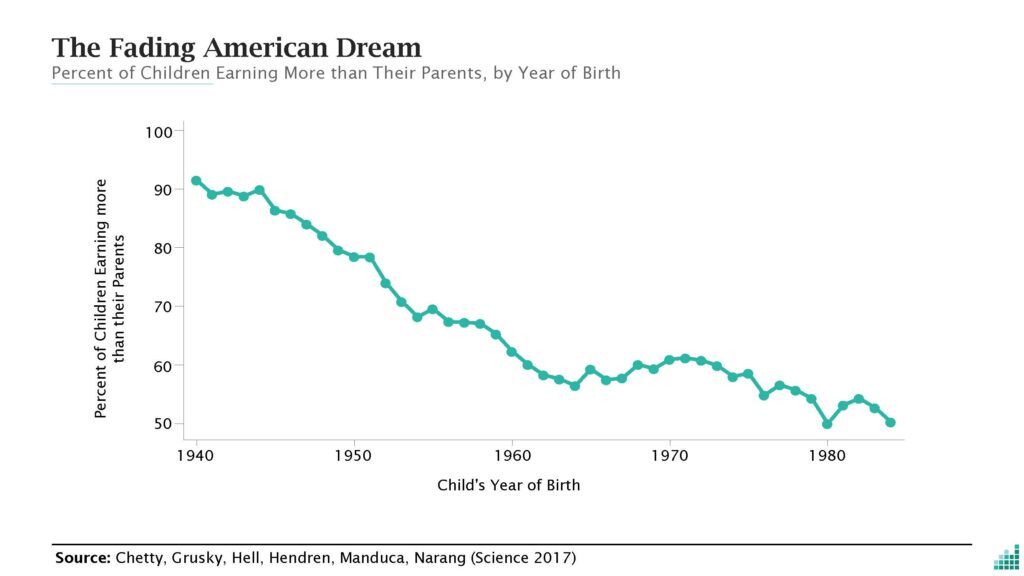
Dr. Chetty shared that economic mobility, as measured by whether an adult child earns more than their parents (adjusting for inflation), has been fading over the past several decades. For American children born in 1940, 92% of them went on to earn more than their parents. But only half of the children born in 1980 did. Digging further into this data, Dr. Chetty revealed that not only is economic mobility fading, but also mobility rates vary dramatically by place.
Click here to watch Dr. Chetty’s presentation.
The Geography of Houston

The map above shows the future incomes of children from low-income families (25th percentile), with red indicating lower future earnings and blue indicating higher earnings. Nationally, the data suggests that economic mobility for children of low-income parents is lowest in the Southeastern region of the U.S. and highest in the Midwest. However, this difference in economic mobility by place is also hyperlocal, meaning we see vast differences in future earnings for low-income children even within the same city.

Dr. Chetty highlighted that if we zoom in on Houston alone, we see the same color patterns we saw on the national map, but with higher variance in the range of adult incomes of low-income children. We see a national range of $20-$55K and, in Houston, a range of $ 10-$60K. A low-income child’s zip code greatly influences their chances of upward mobility.
Neighborhoods have a profound effect on our future outcomes, and either we are lucky enough to grow up in a high-opportunity neighborhood or we aren’t. “Where you grow up really influences life outcomes. When you move just a few miles down the road, that changes outcomes—we need to figure out what is going on that makes some places better than others,” Dr. Chetty expressed.
Click here to read more about the key drivers to increase economic mobility in Houston that define a high-opportunity neighborhood.
Policy Interventions to Increase Economic Mobility

“Although Houston’s gains in mobility are modest—just $350 more in average annual income across two cohorts of low-income children born 15 years apart,” said Dr. Chetty, “they reveal a powerful truth: Houston has many of the foundational ingredients for progress that other cities are still missing. Local leaders are poised to seize the opportunity.”
Dr. Chetty continued by spotlighting three policy approaches to increasing upward mobility in Houston:
Reducing Segregation
Give more low-income families access to higher-opportunity neighborhoods. Dr. Chetty highlighted the Creating Moves to Opportunity Experiment, which tested strategies in the Seattle area to reduce barriers low-income families face when they receive a voucher to move to a high-opportunity area. A voucher alone does not facilitate a lot of these moves. However, suppose you couple the voucher with access to landlords, counselors, and short-term financial assistance. In that case, this vastly increases a family’s likelihood of moving into a high-opportunity area, thereby increasing a child’s future earning potential. This study highlighted that when families receive social support, the possibility of moving to a high-opportunity neighborhood increases.
Place-Based Investments
Revitalize low-income areas by transforming them into high-opportunity areas. Dr. Chetty showcased the HOPE IV Neighborhood Revitalization Program that sought to transform high-poverty neighborhoods into mixed-income communities by revitalizing 261 public housing sites. He shared data showing the impact of revitalization on a child’s income in adulthood, cautioning that, while effective, these programs can be improved by partnering more intentionally with communities and by reducing the negative impacts of displacement. Children who move into these areas after revitalization have significantly higher incomes in adulthood than those who lived in the same neighborhood before investment. Dr. Chetty stressed how the benefits of revitalizing a neighborhood extend beyond income, including reduced crime, increased social capital, and more.
Click here to read more about place-based investment in Houston.
Higher Education & Workforce Training
Amplify the impacts of colleges and training programs on upward mobility. Dr. Chetty cited data showing a correlation between a college’s upward mobility rate and the percentage of low-income students enrolled. The institutions with the highest mobility rates, like Harvard, also have some of the lowest percentages of students from families in the bottom 20 percent. He concluded that a college’s contribution to upward mobility depends on how many students are low-income, and that colleges that serve low-income families tend not to have as great of outcomes.
Dr. Chetty spotlighted Vaughn College of Aeronautics and Technology. This institution enrolls a high percentage of students from low- and middle-income backgrounds and provides them with a well-defined career path that paves the way for economic mobility. He also emphasized the positive impact of programs like Year Up United’s Career Pathways, a comprehensive training program that connects students with leading companies, provides hands-on experience, and helps them build a higher-paying career.
Click here to read more about scholarships and economic mobility in Houston.

Dr. Chetty highlighted statistics underscoring the business case for maximizing economic growth and talent. Data included:
- Patent Rates: The patent rate for people whose parents are in the top 1% of income is 8.1 per 1,000, whereas the patent rate for people with below-median parental income is 0.84 per 1,000.
- Entrepreneurship: Children of parents in the top 1% are 20 times more likely to found a high-employment business than those with below-median parental income.
- Lost Einstein’s: If women, minorities, and children from low-income families invent at the same rate as high-income white men, the innovation rate in America would quadruple.
Society as a whole misses out when we don’t give everyone a fair shot at the American Dream. Data shows that a vast amount of talent and potential is going to waste—talent that could fuel innovation, strengthen our economy, and enrich our communities.
As Opportunity Insights has continued to dig into the drivers of economic mobility, they have uncovered that social capital—specifically economic connectedness—is one of the stronger predictors of upward mobility. Economic connectedness is the degree to which people from lower-income backgrounds are connected to those with higher incomes. In places where these cross-class relationships are strong, children from low-income households are far more likely to climb the income ladder in adulthood.
Click here to explore the connection between social capital and economic mobility in your region.
If we focus on improving childhood environments, view social communities as units of change, and invest in social capital and cross-class connections, Houston can unlock the full potential of its people and serve as a national model for how regions can grow stronger by investing in connection and opportunity.
“This is not charity, it’s not just us helping people in need. This is us helping ourselves. We as a society need to ensure that we are providing as many opportunities as possible. We all will benefit.”
Dr. Ruth N. López Turley, Professor of Sociology and Director of the Kinder Institute for Urban Research
Day One: Table Talks
Learning Together Across Sectors
Informed by the presented data and research, Summit participants began collaborative discussions to explore ways for our region and various organizations in Houston to lead the nation in economic mobility. They surfaced potential ways that our region should think or act differently.

Across table discussions, participants emphasized that for Houston to lead the nation in economic mobility, the region must align around a shared vision and collaborate across sectors. Many called for a coordinated, cross-sector coalition, similar to Houston’s collaborative approach to homelessness, that unites philanthropy, business, government, and nonprofits around common goals, precise definitions, and measurable outcomes. Participants agreed that progress will require investing earlier in education and workforce pathways, ensuring jobs that pay living wages, and addressing foundational barriers such as housing, childcare, and transportation.
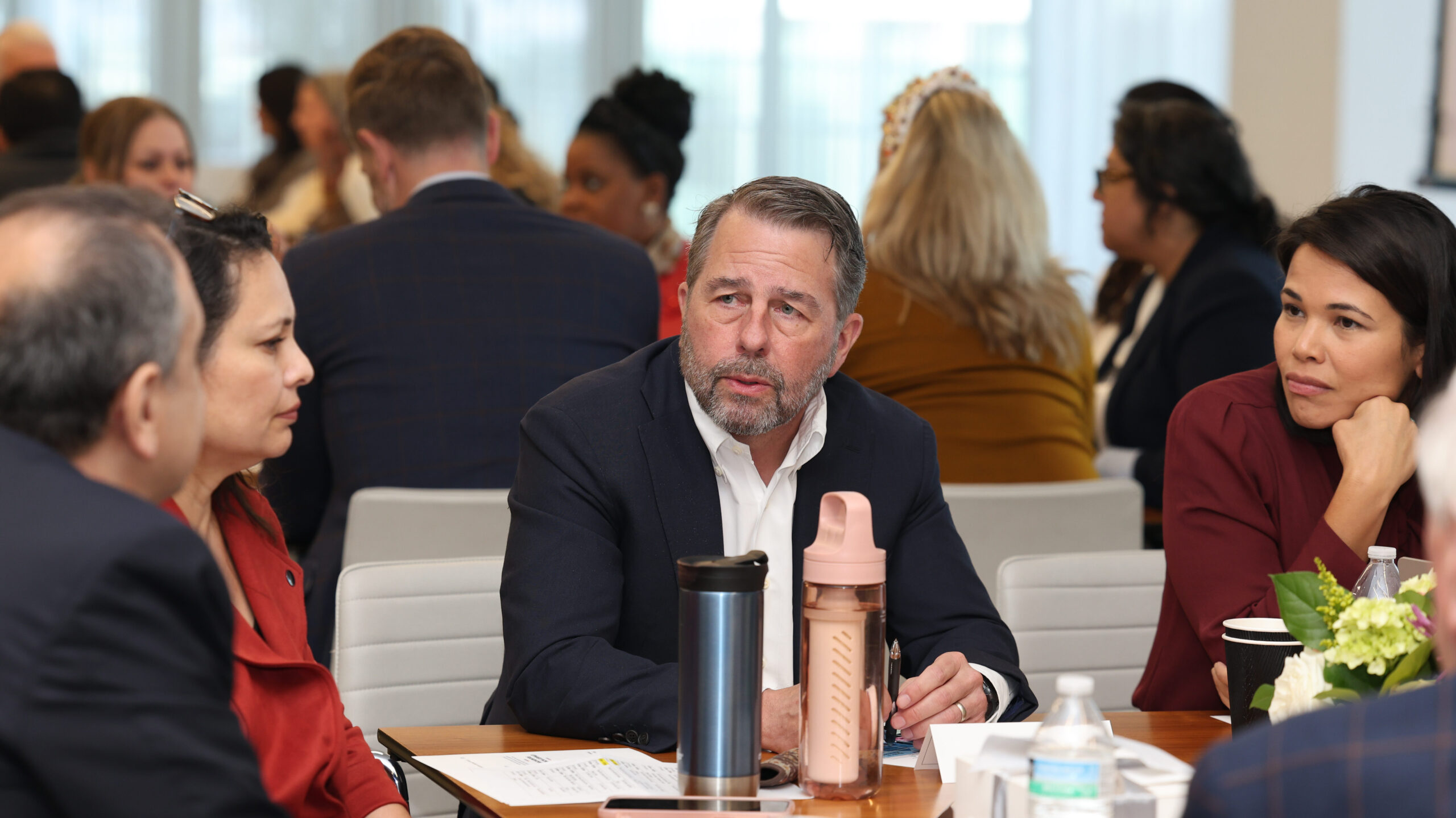
There was also a strong call for businesses and government to play a larger role by offering sustainable wages, investing in talent pipelines, and viewing mobility as an investment in the region’s long-term prosperity. Participants urged philanthropy to catalyze coordination and accountability, emphasizing that meaningful change will depend on sustained collaboration, shared data, and an inclusive approach that brings community voices to the table.
These reflections on the Day One Table Talk discussions are preliminary summaries of the dialogue captured during the Houston Economic Mobility Summit. A more comprehensive summary report synthesizing insights from all sessions and activities will be available at a later date.
Day Two: From Principles to Practice with Sarah Rosen Wartell
How Communities are Advancing Upward Mobility
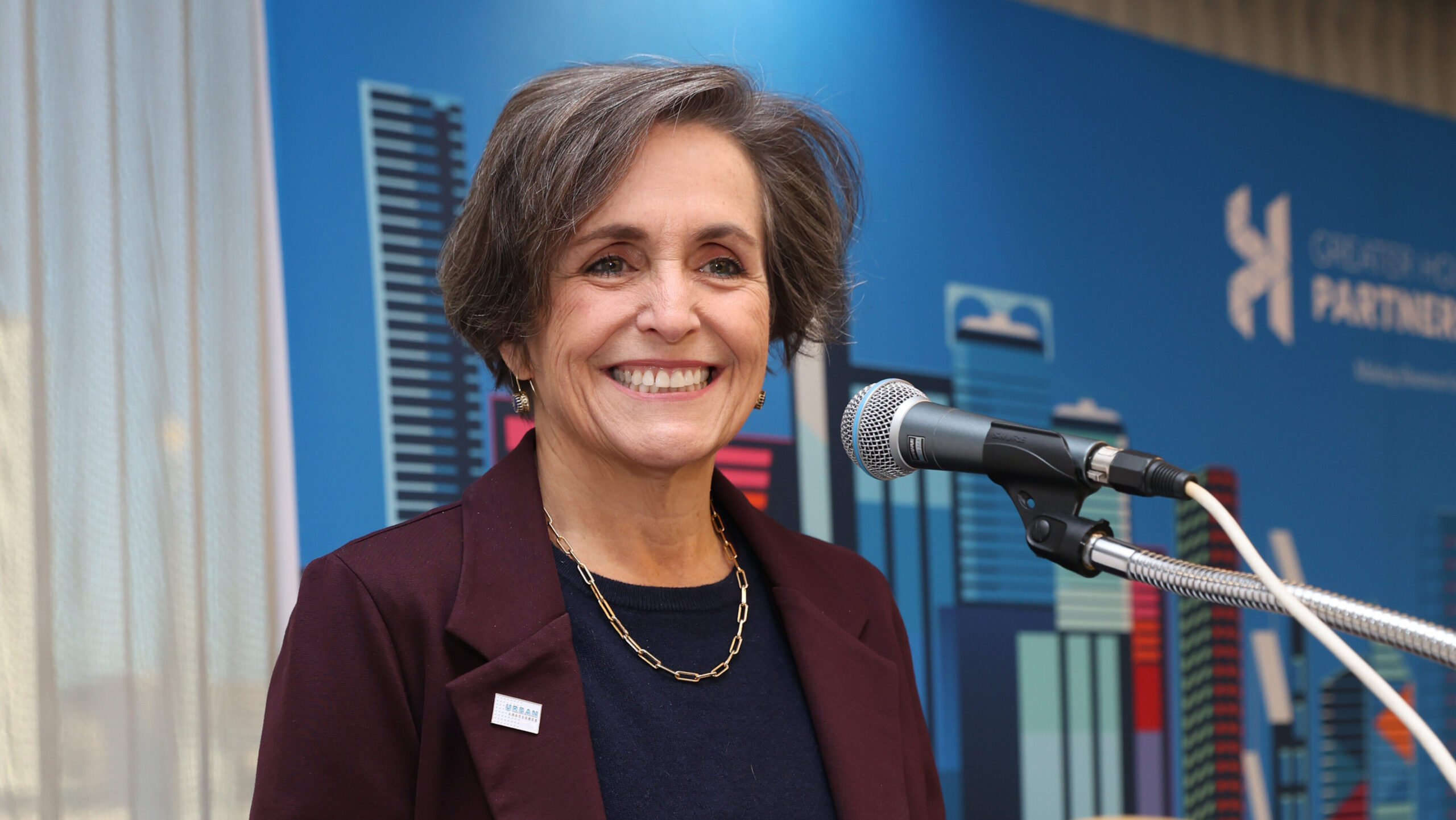
In the words of John Powell, “Poverty is not just about a lack of money, it’s about a lack of power.” To expand on this quote, Sarah shared a three-part definition of mobility from poverty:
- Dignity and Belonging: When people feel respected and that they are meaningfully contributing to their family, work, and community. When they are valued for their contributions.
- Economic Success: When people have enough income and/or capital to provide for their family sufficiently.
- Power and Autonomy: When people have freedom to choose or have influence on things that impact them.
Click here to watch Sarah’s presentation.
The Upward Mobility Framework
What would it take to dramatically improve economic mobility and break the cycle of poverty? Mobility is shaped by far more than income: education, health, housing, environment, and social connections all play a role. Regional, national, and global frameworks to measure and advance upward mobility all include key metrics that cut across issue areas. By embracing economic mobility as a guiding framework, Houston can move towards collective action, improving outcomes across multiple issue areas. The Urban Institute’s Upward Mobility Framework offers a research-based guide to advancing upward mobility. It provides local leaders with a comprehensive definition of mobility and outlines actionable factors to help all people achieve long-term prosperity.
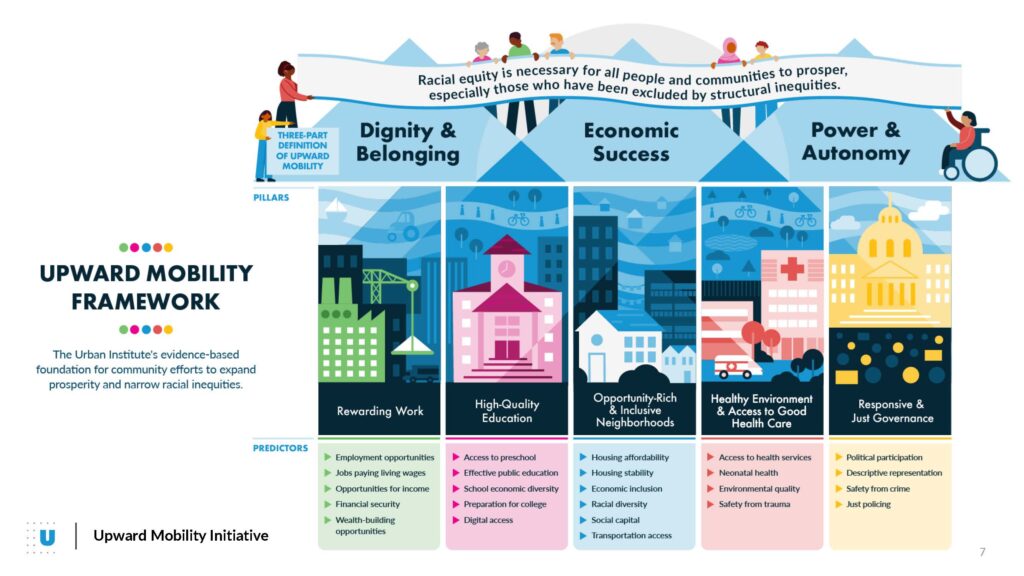
The framework features:
- A three-part definition of economic and social mobility (defined above).
- Five pillars of community support that residents must be able to access to achieve economic and social mobility.
- 24 measurable predictors that communities can influence to strengthen these pillars, giving leaders information on what to change and how.
Sarah continued by sharing statistics that showcase disparities in income levels by race. The Upward Mobility Framework requires that policies, practices, and resources confront and overcome the root causes of today’s inequities and injustices.
Sarah introduced the Urban Institute’s Toolkit for Increasing Upward Mobility in Your Community. This Toolkit walks through multiple ways a cross-sector mobility coalition can ignite meaningful upward movement in their region. Additionally, she highlighted the Urban Institute’s Upward Mobility Data Dashboard, where Houstonians can find a snapshot of metrics and predictors that provide a holistic view of our community’s condition, using the Upward Mobility Framework’s 24 predictors.
Building a Cross-Sector Mobility Coalition
Creating lasting conditions for upward mobility demands a collective effort. Achieving systems change—a profound shift in local practices, values, and power structures—requires partners to think, act, and collaborate in new ways. Sarah stressed the importance of cross-sector collaboration as an integral piece of mobility work. No single organization can do this work alone.
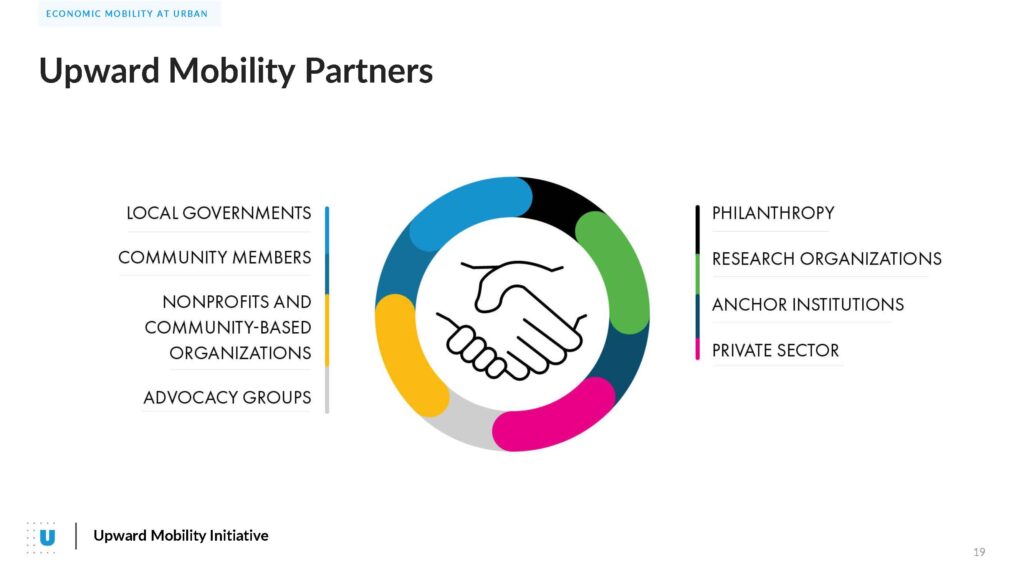
Long-term change comes from building shared understanding, aligning on a common agenda and goals, and securing buy-in from a broad range of actors. “Houston is one of the most diverse and fastest-growing regions in America,” said Sarah. “That makes it a bellwether for what’s possible in advancing economic mobility. But realizing that promise requires ambitious, cross-sector solutions with a long-term commitment to impact.” By working together, Houston can make measurable progress in the near term while laying out the groundwork for transformative, long-lasting opportunities for every Houstonian.
Once the coalition is formed, it’s essential to ensure alignment on the following:
- Coalition’s Work to Date: How and why did you form the coalition?
- Local Mobility Conditions: What shapes opportunities for mobility in your community?
- Community Vision: Strategies for advancing upward mobility.
- Sustainability and Measurement Plan: How to assess and improve efforts.
Sarah emphasized that a region’s journey toward increased mobility is unique to its coalition and location. She expressed that Houston is well-positioned to ignite this type of change; however, it will take the extraordinary institutions represented in the room to help achieve mobility.
Day Two: Fireside Chat with Rich Kinder and Steve Kean
The Role of Business and Philanthropy in Supporting Economic Mobility
The program continued with a fireside chat between Rich Kinder, Executive Chairman of Kinder Morgan and Chairman of the Kinder Foundation, and Steve Kean, President and CEO of Greater Houston Partnership. They spoke about how Houston is an opportunity machine, creating thousands of jobs each year. However, getting low-income people connected to these jobs and opportunities is a different story. Rich Kinder’s response: “It starts with a Kindergarten through 12th grade education, but beyond that, when someone graduates from high school, they don’t get trained for jobs.”

To combat this, Rich spoke about how we all have a role to play—businesses, educational institutions, policy makers, and philanthropy—to move the needle for Houston. Philanthropy can’t solve all the problems, but it can help around the edges and facilitate successful public-private partnerships.
Drawing on his extensive experience across a variety of institutions, Rich notes that lasting success requires coordinated efforts by many. You can’t go at it alone. He highlighted an example of this with the Kinder Foundation’s partnership with Buffalo Bayou Partnership. Before this partnership was finalized, the Kinder Foundation ensured that the city would commit to funding park maintenance for the foreseeable future. “Create agreements where philanthropy puts up part of the work and then the city or county makes specific commitments for maintenance in the future,” Rich declared.
Steve asked Rich about his guiding principle behind his giving. Rich responded, “We believe in transformational grants defined as the transformation of something that would not have gotten done if we didn’t step in and support it.” The Kinder Foundation concentrates its work in Houston because, “you can drive the bus further in an area you really know well,” Rich explained.
One of Rich’s closing statements was sharing a quote by Winston Churchill, “Success is not final, failure is not fatal: it is the courage to continue that counts.” He alluded to how he has made mistakes—he did yesterday, and he will today. However, with strong relationships, clear objectives, and ample communication, Houston can move the needle if we work together.
Click here to hear watch this fireside chat.
Day Two: Houston in Focus with Dr. Flávio Cunha
Laying the Foundations for Upward Mobility
Dr. Cunha began his seminar by describing Houston’s economic paradox. How can a region’s economy grow so fast, yet see mobility remain stagnant? Houston is a dynamic metro, yet rising poverty, limited upward mobility, and job growth concentrated in low-wage occupations.
Click here to watch Dr. Cunha’s presentation.
The Coordination Trap
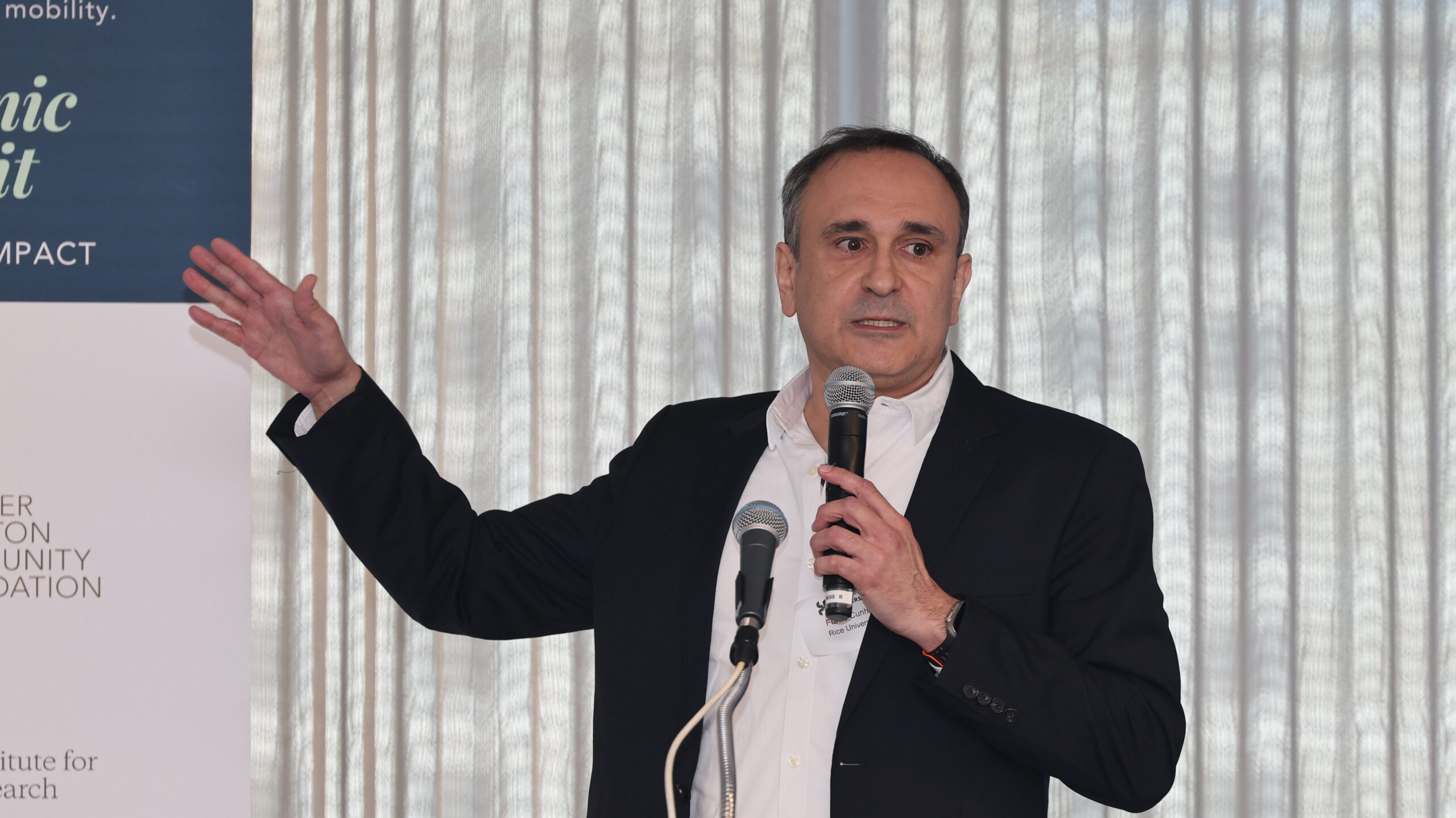
Dr. Cunha highlighted the ‘coordination trap,’ a failure in coordination between employers, individuals, and the education sector. He cites that historic disinvestment in on-the-job learning since the 1970s that has weakened effective coordination, and that economic mobility requires both skilled workers and high-productivity firms. However, today, firms invest only in people who already have skills. Dr. Cunha elaborated, “Employers expect education systems to produce work-ready graduates. Firms are ‘buying’ skills instead of ‘building’ skills internally.”
In simpler terms, Houston’s coordination trap is that it has a flourishing economy while also experiencing widespread poverty. “We’re importing people. We attract brains,” Dr. Cunha explained. “We have a tremendous, booming economy, but we’re not producing the skills that locals need to have to benefit from this growth.” He suggested that our region needs to create a supply-and-demand policy that increases the skills of our local talent while simultaneously creating jobs; only then will we see more economic mobility.
Identifying a North Star
A coordinated approach is the only way our region will achieve advancements in mobility. There needs to be strong partnerships between employers and education, ensuring that the training we give students aligns with what employers value in the labor market.
Measurement is critical for a coordinated mechanism because it creates the feedback loop needed to align education, employers, and the workforce. Defining a clear north star and identifying the indicators to be used should be integrated into Houston’s mobility strategy.
So, what characterizes an effective north star? It must be:
- Valid & Reliable: Something that is accurate and dependable.
- Responsive: If the landscape changes, a unique factor emerges, or new developments arise, they should be included.
- Sensitive & Specific: Ensure that false positives and false negatives are avoided.
Additionally, it inherently needs to be democratic—simple enough for everyone to understand, transparent enough for people to trust, and detailed enough to reveal underlying inequalities. The purpose of the north star metric is to help develop trust and alignment in the communities we aim to advance.
Day Two: Table Talks
Engaging Cross-Sector Leaders to Move Forward
After Dr. Cunha’s remarks, attendees engaged in table discussions and responded to survey questions, providing their thoughts on the possibility of Houston leaders aligning around a “North Star” metric to measure economic mobility, supported by a set of key indicators by issue areas, and which interventions they believe are most in need of collective cross-sector action to drive upward mobility in Houston.
Discussions revealed strong enthusiasm for aligning around a shared “North Star” metric and supporting indicators to measure economic mobility in Houston. Participants rated this idea as very valuable, emphasizing that a common framework could strengthen collaboration, clarify direction, align resources, and create shared accountability. Many saw it as an opportunity to unite organizations around a collective purpose, coordinate funding, and elevate community voices more meaningfully.
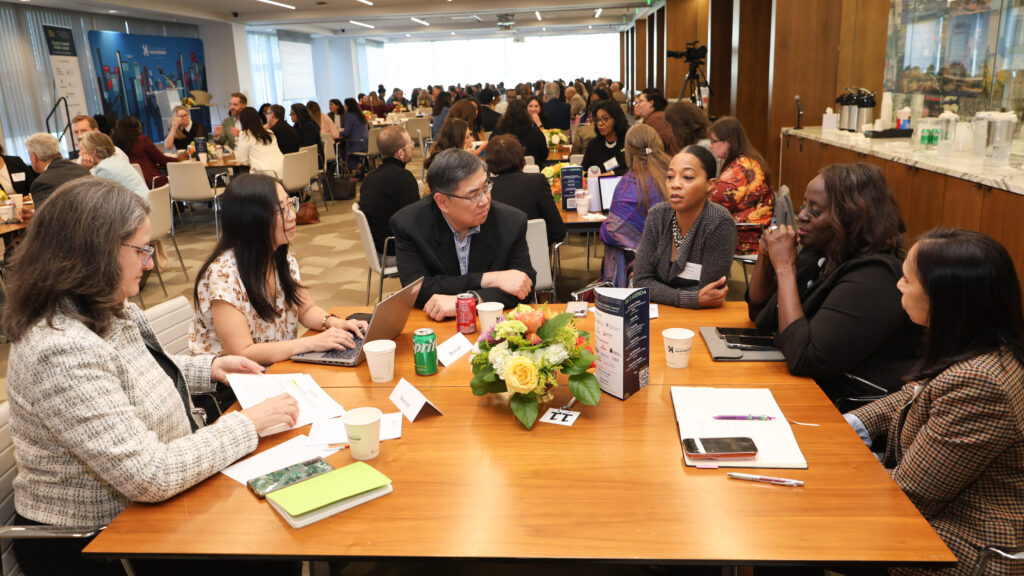
However, participants also cautioned against potential pitfalls such as challenges reaching agreement on the metrics to be included, underinvestment in work not directly tied to selected metrics, and the risk of oversimplifying complex issues. They stressed the importance of ensuring community inclusion, preventing politicization, and maintaining long-term commitments.
When asked to identify the top three most important drivers or interventions to focus on now to advance upward mobility in Houston, participants most frequently cited housing, education, social capital, collaboration, and workforce development as priority areas for collective action.
Attendees were asked to share one word that comes to mind when they think about Houston’s future economic mobility. Many people acknowledged the complexity and difficulty of this issue area, but also reported feeling optimistic and seeing potential and opportunity for Houston’s economic mobility.

These reflections of Day One and Day Two Table Talk discussions represent preliminary summaries of dialogue captured during the Houston Economic Mobility Summit. A more comprehensive summary report synthesizing insights from all sessions and activities will be available at a later date.
Day Two: Moving Forward Together by Ann Stern
A Houston Approach to Collective Action
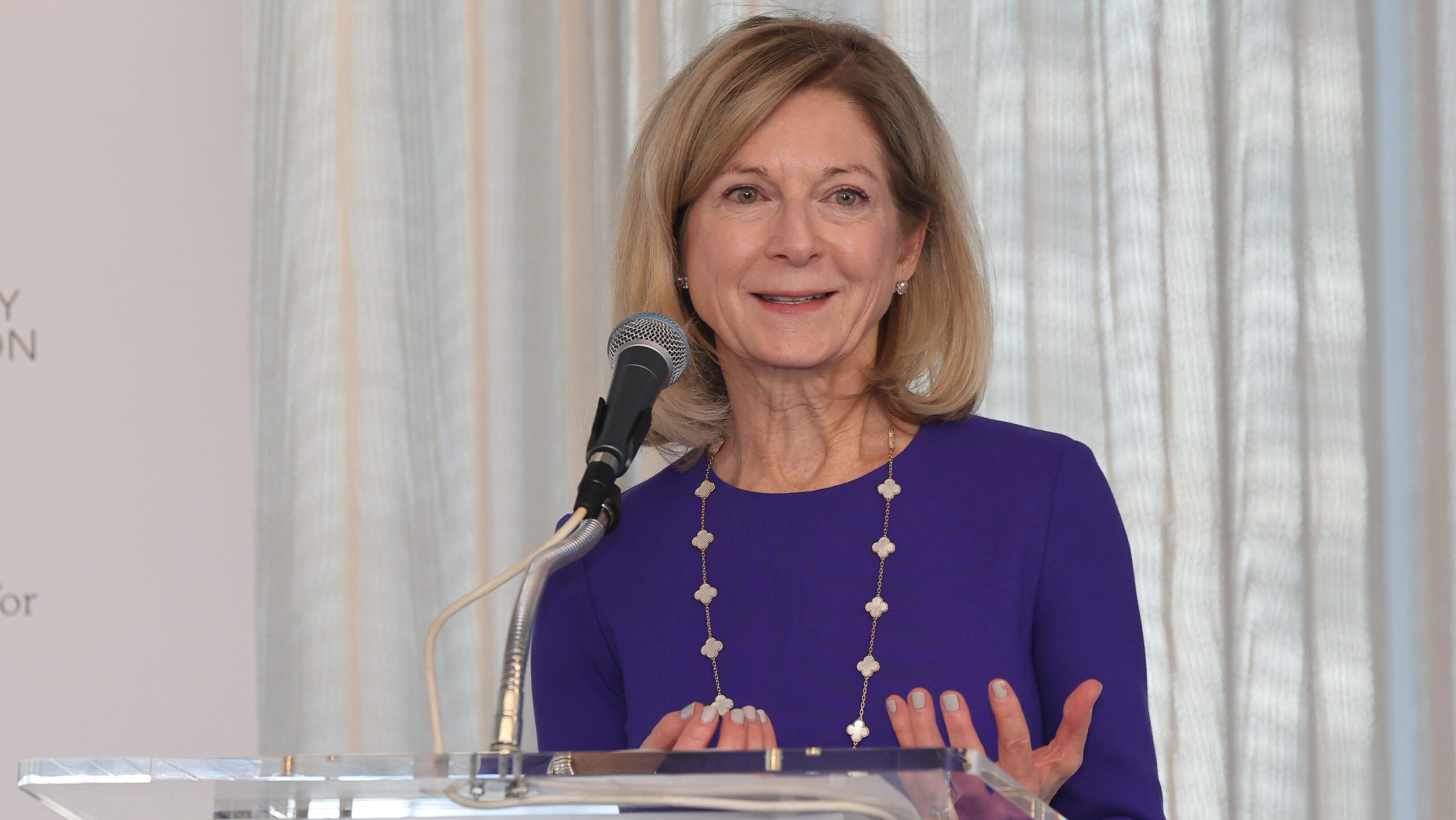
Ann Stern, President and CEO of Houston Endowment, closed the Summit with an inspiring reminder of what Houston is capable of when it comes together around a shared purpose. She emphasized that, “there may be no more urgent question today for this region than this one: How do we provide economic mobility for everyone in Greater Houston?”
Ann reflected on moments when the region has united across sectors to tackle significant challenges: responding collectively in the aftermath of Hurricane Harvey, becoming a national model for reducing homelessness, and transforming Houston’s green spaces into assets for all residents. Each, she noted, is proof that Houston works best when we come together, and each plays their part, contributing to something bigger and helping imagine and execute what is possible.
“Houston is great at going from worst to first. If anyone leaves here today wondering whether we can really shift the trajectory of economic mobility in Houston, let me say plainly—yes, we can. Because when Houston aligns across ideologies, across sectors, and across the aisle, we do extraordinary things.”
Ann Stern, President and CEO of Houston Endowment
Ann’s closing remarks captured the spirit of the Summit: a call to harness Houston’s trademark resilience, optimism, and collaboration to ensure that every Houstonian has the opportunity to thrive. Ann urged everyone, “Let’s be the national model. We’ve done it so many times. We can do it again.”
Greater Houston Community Foundation Collaborating to Advance Upward Mobility
Amplifying Impact Together
While collaboration will be central to the work of the convenors, each organization will also continue to drive its own critical initiatives to improve economic mobility, ensuring that progress happens both collaboratively and within individual spheres of influence.
Greater Houston Community Foundation will continue partnering with donors, nonprofits, and the broader community to serve as a catalytic force for philanthropic impact. We partner with Houston donors to address the city’s most pressing challenges, including economic mobility, through strategic, unique giving solutions that leverage our city’s position as an innovation hub. The Community Foundation offers multiple giving solutions, including recoverable grants, philanthropic loans through donor advised funds, and collaborative grantmaking opportunities, all supported by comprehensive education and due diligence services.
More specifically, the Community Foundation focuses heavily on economic mobility through the three pillars of our Community Impact work—data, collaboration, and lasting impact. Understanding Houston provides data-driven insights that inform community action, guiding initiatives such as the Community Foundation’s High-Impact Grantmaking, which invests in innovative solutions that expand economic mobility. In partnership with United Way of Greater Houston, the Community Foundation also launched the Greater Houston Disaster Alliance to lead the region’s coordinated philanthropic response during disasters.
Every grant and every investment is a chance to build upward mobility for a child, family, or community—especially in undercapitalized neighborhoods. Stephen Maislin, President & CEO of the Community Foundation, shared, “Our role as a community foundation is to bring together donors, data, and partners to make philanthropy more impactful. True upward mobility will only come from bold, coordinated action—and philanthropy has a critical role to play in ensuring those efforts are sustained and accountable.”
Bold, Aligned Action
Houston’s Long-term Commitment
We want to express our heartfelt gratitude for the co-convenors and supporting partners for making this gathering possible. This Summit is not just about sharing ideas—it’s a call to align on action. Defining what we will do together, how we will measure progress, and how we will hold ourselves accountable for meaningful results.
Houston is one of the most diverse and fastest-growing regions in the country. Its modest mobility gains, coupled with its diversity and economic scale, position it as an incubator for what is possible in metropolitan areas across the country. By advancing bold, collaborative solutions, Houston has the potential to be a national model for upward mobility. Will we seize the opportunity?
The Summit is not just a one-time conversation—it marks the beginning of a long-term commitment. Convenors and participants will continue to refine priorities, align around shared goals, and pursue collective actions that delivers measurable, lasting progress for Houstonians.
More Helpful Articles by Greater Houston Community Foundation
- Driving Changes with Data: Key Drivers to Increase Economic Mobility in Houston
- Advancing Impact Donor Breakfast: Building Thriving Neighborhoods
- Amplified Collaborative Giving in Houston: Fueling High-Impact, Community-Driven Solutions
- Greater Houston Disaster Alliance: Building Systems of Support
This website is a public resource of general information that is intended, but not promised or guaranteed, to be correct, complete, and up to date. The materials on this website, including all comments and responses to comments, do not constitute legal, tax, or other professional advice, and is not intended to create, and receipt or viewing does not constitute, nor should it be considered an invitation for, an attorney-client relationship. The reader should not rely on information provided herein and should always seek the advice of competent legal counsel and/or a tax professional in the reader’s state or jurisdiction. The owner of this website does not intend links on the website to be referrals or endorsements of the linked entities.